Need help with booking? Send us a message.
The Annapurna Base Camp via Poon Hill Trek stands as one of the most complete trekking experiences in the world. Often referred to as the ultimate Himalayan double-feature, this journey blends two of Nepal’s legendary trekking trails into a single, seamless 14-day loop. Instead of rushing directly to the high-altitude sanctuary, this route takes you on an expansive detour through deep forests, ancient farming terraces, and cultural hotspots.
You do not just walk to a mountain; you watch the landscape shift from sub-tropical river valleys to alpine forests, and finally to a barren glacial world surrounded by a 360-degree wall of rock and ice. This comprehensive guide covers everything you need to know to prepare for this bucket-list adventure.
Annapurna Base Camp (ABC) Trek via Poon Hill is a popular and rewarding trekking route in the Annapurna region of Nepal. This trek combines the stunning views from Poon Hill with the breathtaking landscapes and cultural experiences of the Annapurna Base Camp. Here is a detailed overview of the Annapurna Base Camp trek via Poon Hill.
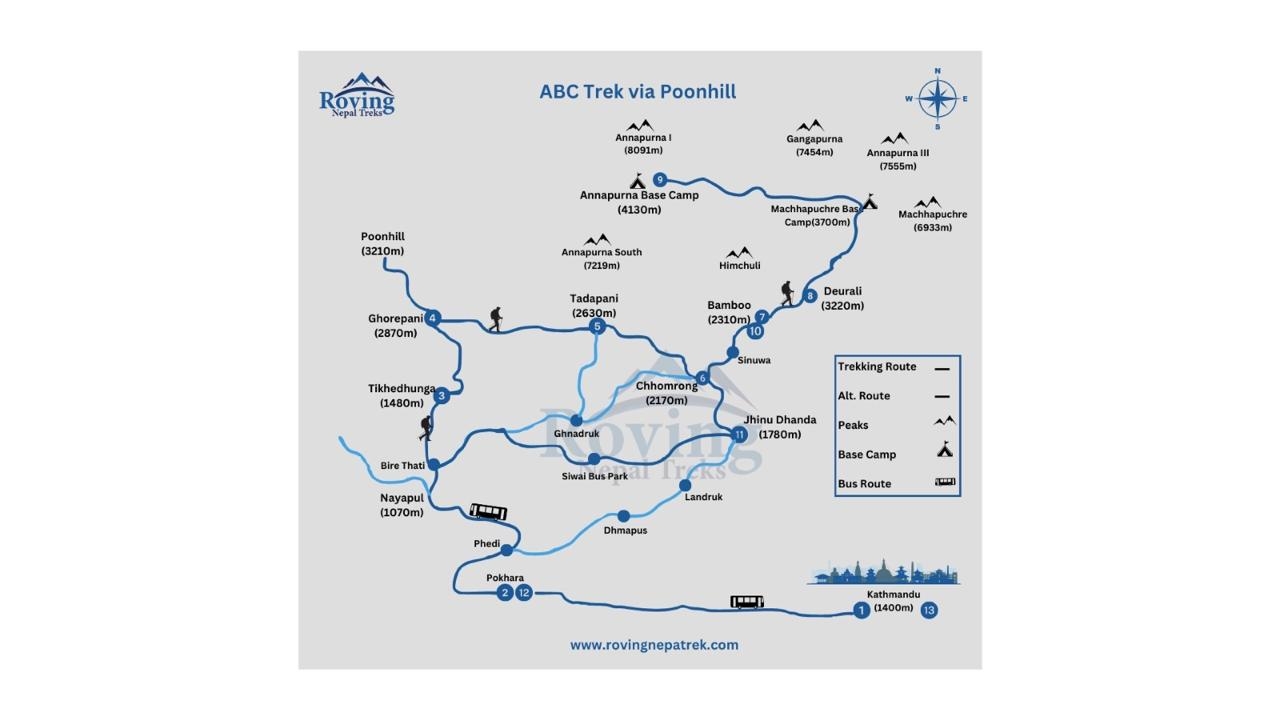
The trek begins with a scenic drive from Pokhara to Nayapul, the starting point of the trek. From Nayapul, you start trekking through beautiful villages, terraced fields, and lush forests, gradually ascending along the Modi Khola River.
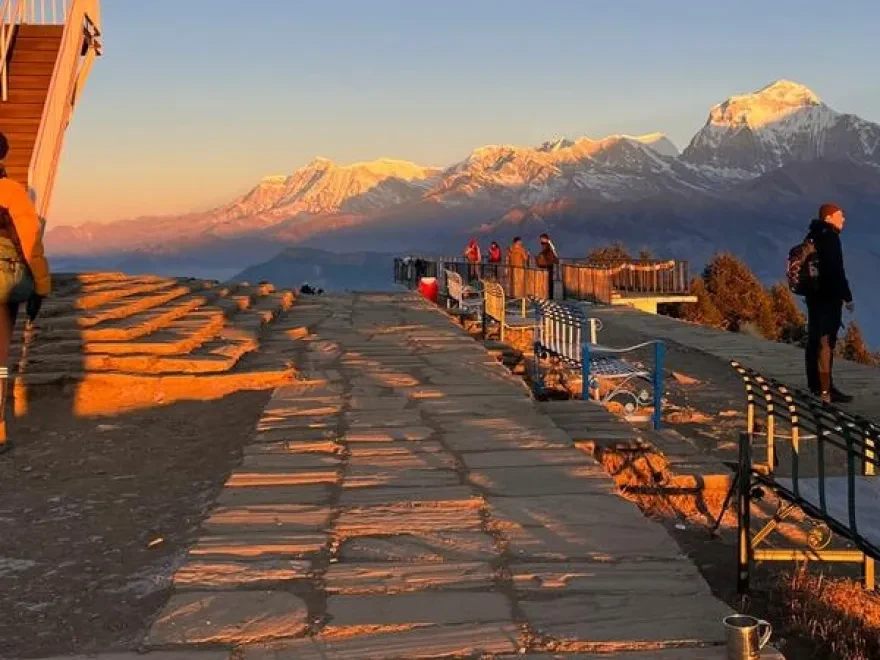
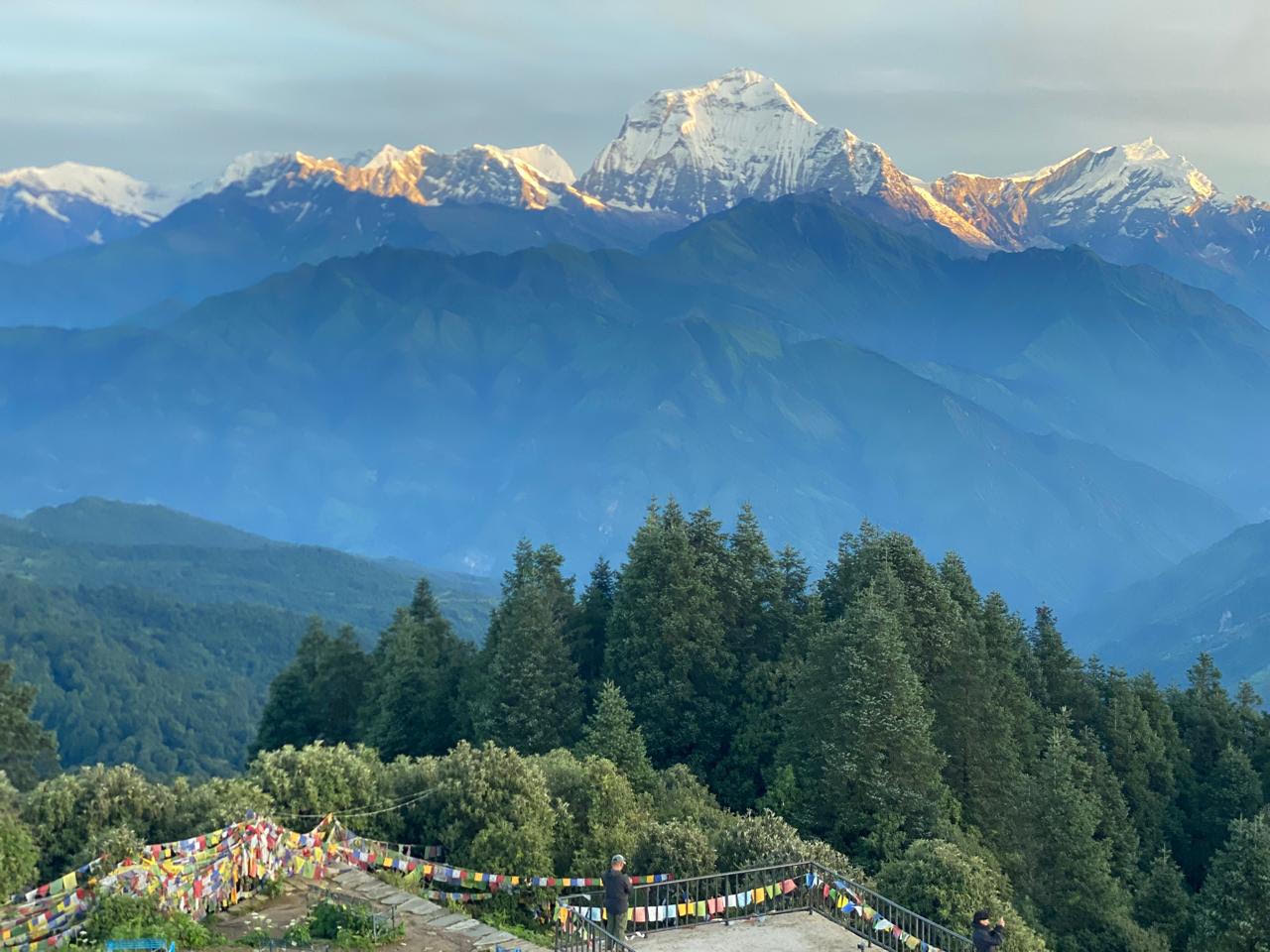
After a few days of trekking, you reach the famous viewpoint of Poon Hill (3,210 meters) before sunrise. From Poon Hill, you are rewarded with a breathtaking panoramic view of the Annapurna and Dhaulagiri mountain ranges, including peaks like Annapurna I (8,091 meters), Machhapuchhre (Fishtail) Mountain (6,993 meters), and Dhaulagiri (8,167 meters). The sunrise over the snow-capped mountains is a mesmerizing experience.
Continuing on the trek, you descend to the beautiful village of Tadapani and then make your way towards Chhomrong, a Gurung village with stunning mountain views. The trail then takes you through dense forests, terraced fields, and charming villages, such as Bamboo and Deurali.
As you approach Machhapuchhre Base Camp (3,700 meters), you enter a glacial valley surrounded by towering peaks. The close-up views of Machhapuchhre (Fishtail) Mountain are truly awe-inspiring.
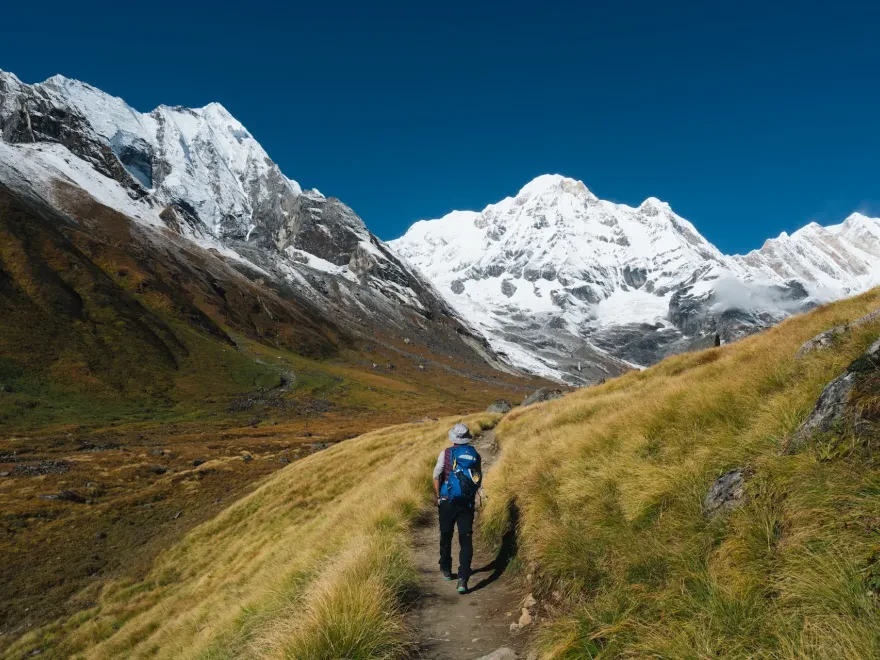
From Machhapuchhre Base Camp, the trail leads you to the ultimate destination of Annapurna Base Camp (4,130 meters). This hidden sanctuary is located at the foot of the massive Annapurna South (7,219 meters) and Annapurna I. As you stand at the base camp, you are surrounded by a natural amphitheater of towering peaks, creating a sense of awe and accomplishment.
After spending time at the base camp, you retrace your steps back to Bamboo, passing through beautiful landscapes, dense forests, and charming villages along the way. From Bamboo, you trek downhill to Nayapul and then drive back to Pokhara.
While a direct route to Annapurna Base Camp (ABC) is shorter, the combined itinerary via Poon Hill is vastly superior for several key reasons:
· Superior Acclimatization: By spending your first few trekking days climbing gradually to Poon Hill (3,210m), your body naturally adapts to the thinning air. This significantly reduces the risk of Altitude Sickness (AMS) later in the trip when you cross the 4,000-meter mark.
· A Diverse Visual Palette: Direct routes can feel somewhat linear. The Poon Hill variation introduces you to the classic ridge-line views of the lower Annapurna range before plunges you into the deep gorges of the Modi Khola river.
· Deep Cultural Immersion: This longer route passes through a variety of ethnic settlements, letting you witness the unique cultures of the Gurung and Magar communities in villages like Ghorepani, Ulleri, and Chhomrong.
The geographical layout of this trek is nothing short of spectacular. The trail acts as a natural staircase, transitioning through several distinct ecological zones as you gain altitude.evation Profile Visualizer:
Your journey begins in the lush lower foothills of the Annapurna Conservation Area. Here, the landscape is defined by rolling green hills, dense sub-tropical forests, and spectacular terraced farms that seem to cling precariously to the hillsides. As you climb toward Ghorepani, the air grows cooler and the forests change to ancient oak and rhododendron. The ridge-line at Ghorepani acts as a natural viewing platform, offering a dramatic barrier between the deep valleys and the high peaks.
Once you descend from the Ghorepani ridge, the geography changes dramatically. You enter the deep, steep-sided gorge of the Modi Khola river. This river drains the entire glacial melt of the Annapurna Sanctuary. The trail here is carved directly into the valley walls, winding through dense bamboo groves and oak forests. As you climb past Deurali, the valley suddenly pinches closed, only to open up into the high-altitude, oval-shaped glacial basin known as the Annapurna Sanctuary.
Timing is everything when planning a trek in the Himalayas. The weather patterns in Nepal divide the trekking year into four distinct seasons, each offering a completely different experience.
| Season | Months | Weather Conditions | Trail Highlights |
|---|---|---|---|
| Spring | March to May | Warm days, clear mornings, occasional afternoon clouds | Blooming rhododendron forests, green valleys |
| Autumn | September to November | Crisply clear skies, dry trails, cool temperatures | Maximum visibility, peak festive season |
| Winter | December to February | Very cold, heavy snow at high altitudes | Quiet trails, dramatic snowscapes |
| Monsoon | June to August | High rainfall, slippery trails, cloud cover | Lush greenery, cascading waterfalls |
Springtime Rhododendron Blooms (March to May)
Spring is widely considered one of the two golden windows for trekking in the Annapurna region. During these months, the lower hillsides erupt into a sea of red, pink, and white as the giant rhododendron forests bloom. The temperatures are comfortably warm at lower elevations, and the high-altitude base camp begins to thaw out. While there can be occasional afternoon clouds, the morning views are spectacular.
Golden Autumn Views (September to November)
Autumn is the absolute peak season for trekking in Nepal. After the monsoon rains wash away the dust, the atmosphere is exceptionally clean and dry, resulting in razor-sharp mountain views. The weather is highly stable, making it the safest time to head into high-altitude areas like ABC. However, because the conditions are so perfect, the trails and tea houses during these months can be quite busy.
Can You Trek ABC via Poon Hill in Winter or Monsoon?
While possible, trekking during winter or monsoon presents significant challenges:
· Winter (December–February): High-altitude passes and the path between Deurali and MBC can experience heavy snowfall and avalanche risks. Many tea houses close, and temperatures drop far below freezing.
· Monsoon (June–August): The trails are wet, slippery, and prone to leeches. Heavy cloud cover often hides the mountains, and landslides can cause travel delays along the highways.
The Annapurna Base Camp via Poon Hill Trek is rated as moderate to challenging. You do not need any technical climbing skills, ropes, or crampons, but you must possess a solid level of physical endurance.
"A trekker's attitude on the trail is just as important as their physical preparation. Pace yourself, stay hydrated, and enjoy the journey rather than focusing solely on the destination."
One of the most famous challenges on this route is the steep stone staircase leading up to Ulleri on Day 4. Consisting of more than 3,000 stone steps, this section tests your leg strength and cardiovascular endurance. The key to conquering Ulleri is to take slow, rhythmic paces, keep your breathing steady, and take frequent short breaks to look back at the expanding valley views.
As you trek past 3,000 meters, the atmospheric pressure drops, meaning there is less oxygen with every breath.
To stay safe and avoid Acute Mountain Sickness (AMS), we strictly implement the following guidelines:
1. Walk Slow (Bistari, Bistari): Never rush to catch up with others. Keep a pace where you can easily hold a conversation.
2. Hydrate Constantly: Drink 3 to 4 liters of clean water daily.
3. Avoid Alcohol and Sleep Medication: These can suppress your breathing and mask altitude symptoms.
4. Ascend Gradually: Our 14-day itinerary limits daily sleeping elevation gains to safe limits.
To legally enter and trek through the Annapurna Conservation Area, you must secure two main permits. At Roving Nepal Trek, we handle all of this paperwork for you prior to your arrival:
· Annapurna Conservation Area Project (ACAP) Permit: This permit supports local conservation efforts, trail maintenance, and community development within the region.
The Annapurna region features some of the best-developed trekking infrastructure in Nepal. You will be staying in local tea houses—family-run mountain lodges that offer basic but cozy rooms and hot meals.
· The Rooms: Typically consist of twin single beds with foam mattresses, clean sheets, pillows, and heavy blankets.
· The Restrooms: Lower down, many lodges offer attached bathrooms with hot showers. As you get higher, bathrooms become shared, and hot showers may require a small additional fee (heated via gas or solar power).
· The Food: Menus are surprisingly diverse, featuring the traditional staple Dal Bhat (lentil soup, rice, and vegetable curry), pasta, noodles, pancakes, oatmeal, and fresh eggs.
For travelers seeking elevated comfort, we offer an Upgraded Lodging Package. In key destinations along the lower loop (like Tikhedhunga, Ghorepani, and Jhinu Danda), we bypass standard rustic tea houses and book you into premium lodges. These properties offer private, en-suite bathrooms, heated rooms, softer bedding, and more extensive dining options, allowing you to recover in total comfort.
To ensure you enjoy every step of your 14-day trek rather than just enduring it, we recommend beginning a targeted physical training plan 4 to 6 weeks before your trip:
1. Cardiovascular Training: Build your aerobic base with running, cycling, swimming, or rowing 3 to 4 times a week.
2. Leg Strength: Incorporate squats, lunges, step-ups, and calf raises into your workouts to prepare your legs for the thousands of downhill and uphill steps.
3. Practice Hikes: If possible, go on weekend day-hikes wearing your trekking boots and a loaded backpack. This helps condition your shoulders, core, and feet.
Choosing the right local partner is essential for a safe, stress-free, and deeply rewarding Himalayan adventure. When you book with Roving Nepal Trek, you benefit from:
· Expert Local Guides: Our guides are fully licensed, first-aid certified, and hold years of experience navigating the Annapurna trails.
· Ethical Porter Treatment: We strictly adhere to ethical porter guidelines, ensuring fair wages, appropriate load limits, and proper gear for our field staff.
· Seamless Logistics: From airport transfers and high-quality private vehicles to permit acquisitions and lodging bookings, we manage every single detail of your journey so you can focus entirely on the mountains.
The Annapurna Base Camp trek via Poon Hill offers a perfect combination of stunning mountain views, diverse landscapes, cultural encounters, and a sense of adventure. It allows trekkers to experience the beauty of the Annapurna region and witness the grandeur of the Himalayas up close.
Mandatory Travel Insurance: Your travel insurance policy must specifically cover high-altitude trekking up to 5,000 meters (16,400 feet) and include emergency helicopter evacuation. Standard travel insurance often excludes adventure sports and high altitudes. Please send us a copy of your policy before your trek begins.
Embrace Itinerary Flexibility: Mountain weather is notoriously unpredictable. Flight delays between Kathmandu and Pokhara, road blockages due to landslides or heavy rain, or sudden snowfall near Machhapuchhre Base Camp can occasionally disrupt the schedule. We highly recommend booking your international return flights with a buffer day or two at the end of your trip.
The Guide’s Decision is Final: Our guides are trained in wilderness first aid and high-altitude safety. If a trekker shows severe signs of Acute Mountain Sickness (AMS) or if trail conditions become hazardous due to avalanche risks, the lead guide has the ultimate authority to alter the route or order a descent. Safety will never be compromised for the sake of the itinerary.
Porter Weight Limitations: To protect the health and well-being of our hardworking team, we enforce a strict weight limit of 15 kg (approx. 33 lbs) per trekker for your main duffel bag carried by the porter. You will carry your own daypack with essentials like water, layers, and cameras.
Arrive in Kathmandu, the capital city of Nepal. You will be greeted at the airport and transferred to your hotel. Spend the day exploring the city, visiting cultural sites, and preparing for the trek. Overnight stay in Kathmandu.
Take a scenic drive from Kathmandu to Pokhara, a beautiful lakeside city that serves as the gateway to the Annapurna region. Enjoy the scenic landscapes and settle into your hotel in Pokhara. Overnight stay in Pokhara.
After breakfast, drive from Pokhara to Nayapul, the starting point of the trek. Begin trekking along the banks of the Modi Khola, passing through small settlements and terraced fields. Reach Tikhedhunga and rest for the night. Overnight stay in Tikhedhunga.
Continue trekking, ascending a steep stone staircase to the village of Ulleri. Trek through dense rhododendron and oak forests, passing by waterfalls and enjoying the natural beauty. Arrive at Ghorepani, a charming village with panoramic mountain views. Overnight stay in Ghorepani.
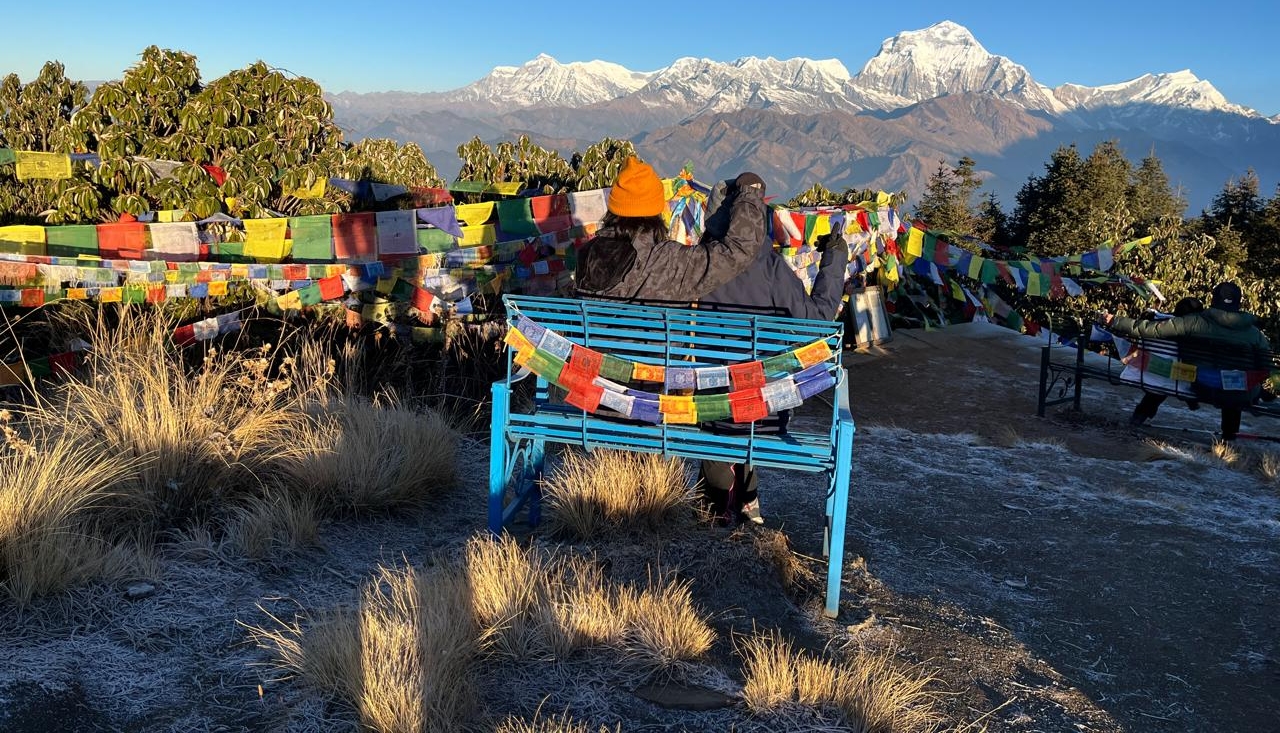
Wake up early in the morning and hike up to Poon Hill to witness the breathtaking sunrise over the Annapurna and Dhaulagiri mountain ranges. Enjoy panoramic views of the snow-capped peaks. Descend to Ghorepani for breakfast and then trek to Tadapani through forests and beautiful landscapes. Overnight stay in Tadapani.
Descend through rhododendron forests and traverse terraced fields, enjoying occasional mountain views. Reach Chhomrong, a Gurung village known for its hospitality and stunning mountain vistas. Overnight stay in Chhomrong.
Descend through a stone staircase and cross the Chhomrong Khola. Trek through bamboo forests, passing by small settlements. Enjoy the scenic beauty and reach Bamboo for an overnight stay.
Continue trekking along the trail, passing through dense forests of bamboo, rhododendron, and oak trees. Ascend to Deurali, situated in a glacial valley with breathtaking mountain views. Overnight stay in Deurali.
Trek through the Machhapuchhre Base Camp, enjoying the close-up views of Machhapuchhre (Fishtail) Mountain. Continue on the trail to Annapurna Base Camp, surrounded by towering peaks. Reach the base camp and marvel at the panoramic vistas of the Annapurna massif. Overnight stay in Annapurna Base Camp.
Wake up early to witness the sunrise over the mountains from Annapurna Base Camp. After breakfast, begin descending the trail, retracing your steps back to Bamboo. Enjoy the beautiful landscapes and lush forests along the way. Overnight stay in Bamboo.
Continue descending through forests and terraced fields, passing by small villages. Reach Jhinu Danda, famous for its natural hot springs. Take a refreshing dip in the hot springs to relax your muscles after the trek. Overnight stay in Jhinu Danda.
Descend further to Nayapul, following the trail along the Modi Khola. Reach Nayapul and board a vehicle for the drive back to Pokhara. Enjoy a relaxing evening by the lakeside. Overnight stay in Pokhara.
Take a scenic drive from Pokhara back to Kathmandu, enjoying the picturesque landscapes along the way. Upon arrival in Kathmandu, transfer to your hotel. Spend the rest of the day at leisure, exploring the city or shopping for souvenirs. Overnight stay in Kathmandu.
After breakfast, transfer to Tribhuvan International Airport for your departure flight, carrying unforgettable memories of the Annapurna Base Camp Trek via Poon Hill and your time in Nepal.
Trekking in the Himalayas is an incredible experience, but the day-to-day logistics can be quite different from Western hiking trails. Here is some practical insider advice to help you navigate daily life on the trail:
Once you leave Pokhara, there are no ATMs along the trekking route. Local tea houses do not accept credit cards, traveler’s checks, or foreign currency.
· Plan to exchange cash in Kathmandu or Pokhara.
· We recommend carrying around NPR 3,000 to 4,000 (approx. $25–$35 USD) per day in small-denomination Nepalese Rupees to cover personal expenses like bottled water, snacks, hot showers, device charging, and Wi-Fi.
While you are walking through remote valleys, you won't be entirely cut off from the world—but staying connected comes with a cost:
· Charging Devices: Most tea houses charge a fee ranging from NPR 200 to NPR 500 ($1.50 to $4 USD) to charge phones, cameras, or power banks. Charging is often done in the communal dining hall, so bringing a high-capacity power bank (20,000mAh+) is highly recommended.
· Wi-Fi and SIM Cards: Paid Wi-Fi cards (such as Everest Link or local tea house networks) are available, but connection speeds can be erratic. For cellular data, both Ncell and NTC (Nepal Telecom) SIM cards work reasonably well up to Chhomrong, after which signal coverage becomes highly spotty or non-existent.
Single-use plastic water bottles are strictly banned past a certain point in the Annapurna Conservation Area to protect the fragile environment.
· You must bring reusable, heavy-duty water bottles or a hydration bladder.
· You can purchase boiled, filtered water at the tea houses, or bring water purification tablets/UV filters (like a SteriPEN) to treat tap water along the way.
As you climb higher, the energy required to heat water increases significantly.
· In lower villages, solar or gas-heated showers may be included in your stay or cost a nominal fee.
· Above Chhomrong, expect to pay NPR 300 to NPR 500 per hot shower. At the highest stops, "showers" are often a bucket of hot water. Many trekkers opt for biodegradable wet wipes for a "mountain bath" once they pass 3,000 meters to avoid catching a cold.
Tipping is not legally mandatory, but it is deeply ingrained in Nepalese trekking culture and serves as a direct way to thank your field staff for their hard work.
· As a general guideline, groups typically pool together to tip their guide around $15 to $20 USD per day and their porter around $10 to $15 USD per day (distributed at the end of the trek).
Your Start Date is the day you land in Nepal, and your End Date is when you fly home.
If the set Annapurna Base Camp via Poon Hill Trek group dates don’t suit your schedule, we can offer alternative dates upon request.
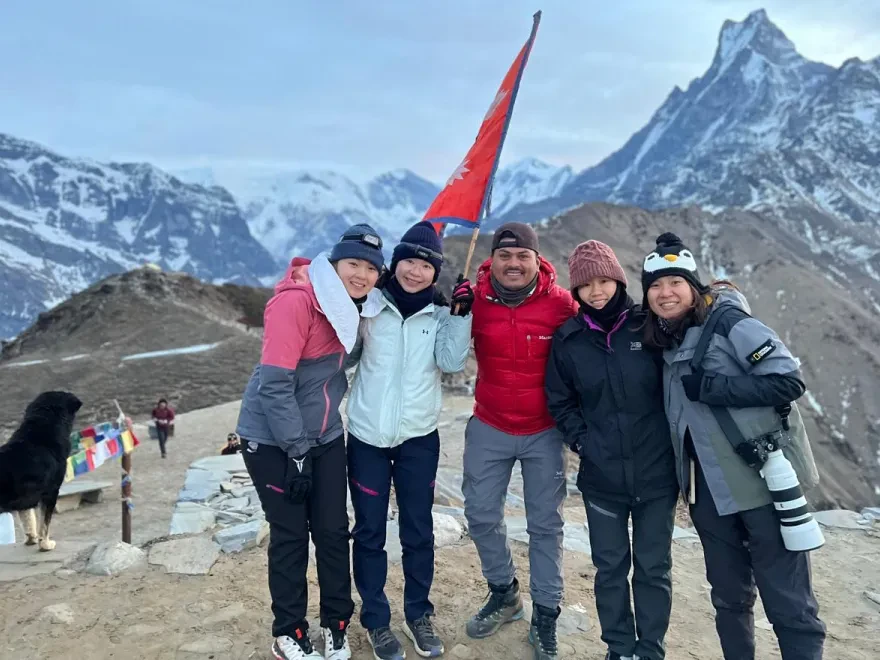
We’re so lucky that we saw a magnificent view of the Annapurna mountains especially with our professional guide- Prabin!! Very heart-warming, helpful, and with lots of knowledge in mountains. We also learned many Nepali culture from him. Felt very thankful that we were able to achieve ABC even with a bit of rain & snow, and seeing the awesome view will definitely be an unforgettable memory of life! Thank You RNT for managing our trek!!
It is my first time in Nepal. It is an unforgettable journey in these 14 days. I am glad that we joined the Roving Nepal Trek for 8D7N Poonhill and Annapurna base camp. Besides the trekking, they also arranged the airport pick up and drop off, all the accommodations in Kathmandu and Pokhara. I am very appreciative of the whole organization of the itinerary. Our guide Santosh and our porters were very helpful and experienced; they took good care of us during the trekking. Also, we can have fresh fruit for dinner during the trekking. It‘s really surprising us. It was raining every day at nearly 3 o’clock during the trekking, and there was a snowy trail from MBC to ABC, raincoats and crampons were needed. One of our members hasn’t brought the raincoat and crampon. Santosh lent his equipment to her. How nice is he! We spent lots of time enjoying the breathtaking views; and taking pictures and videos during the trekking. Santosh did not urge us to go and also he is a professional photographer, he took a lot of fabulous photos for us. We have an unforgettable experience in Kathmandu. Basu knows that we would like to try the saree-style dresses. One of his family members lent her dresses to us and also helped us to dress up. It is an amazing experience that I will never forget. “NATURALLY NEPAL Once is not enough” If I go trekking in Nepal in the future, I will join the Roving Nepal trek with no hesitation.
The combined trek typically takes 10 to 12 days starting and ending in Pokhara. Adding the Poon Hill loop adds about 2 days to a direct ABC route, but it offers crucial acclimatization and iconic sunrise views.
The highest point reached is Annapurna Base Camp itself, sitting at 4,130 meters (13,549 feet). Poon Hill, which you visit earlier in the trek, stands at 3,210 meters (10,531 feet).
It is classified as a moderate trek. No technical climbing or mountaineering experience is required. However, you will be walking 5 to 7 hours a day on steep, stone-stepped terrain, so a good baseline of cardio fitness is highly recommended.
Focus on cardiovascular endurance and leg strength at least 4 to 6 weeks before you go. Hiking, running, cycling, and stair-climbing are excellent prep. Practice walking in the actual boots you plan to wear to avoid blisters.
Your core gear should include a sturdy 30–40L backpack (if using a porter) or 50–60L (if carrying yourself), broken-in hiking boots, a down jacket, a sleeping bag rated to -10°C, moisture-wicking layers, a waterproof shell, trekking poles, and a reliable headlamp.
Yes, easily. Both Kathmandu (Thamel) and Pokhara (Lakeside) are packed with gear shops where you can buy or rent down jackets, sleeping bags, poles, and clothing for a fraction of retail prices.
You will be staying in traditional teahouses (local lodges). Rooms are basic, typically featuring twin beds with thin mattresses and shared bathrooms. As you get higher up, electricity and hot water may incur a small extra fee.
Teahouses offer surprisingly extensive menus. The staple is Dal Bhat (rice, lentil soup, and vegetable curry), which is fresh, filling, and high-energy. You will also find pasta, potatoes, eggs, pancakes, and soups. It is best to avoid meat at higher altitudes as it is carried up by porters and may not be fresh.
Do not drink untreated tap water. You can buy boiled water at teahouses, or bring water purification tablets, a UV purifier, or a filtration bottle (like a LifeStraw or Grayl) to treat tap/stream water. Avoiding single-use plastic bottles also helps protect the mountain ecosystem.
The prime trekking seasons are:
· Autumn (October – November): Offers the clearest skies, crisp weather, and breathtaking mountain views.
· Spring (March – May): Features warmer temperatures and beautiful blooming rhododendron forests.
Winter (December–February) is freezing at high altitudes and passes may close due to heavy snow. Monsoon season (June–September) brings heavy rains, mud, leeches, and obscured views. While possible, both seasons require specialized preparation and flexible timelines.
Important Update: The Government of Nepal requires all foreign trekkers in Nepal's national parks and conservation areas to hire a licensed guide. Solo trekking without a guide is no longer permitted for safety and environmental tracking.
Symptoms include headaches, dizziness, nausea, loss of appetite, and fatigue. The best management is prevention: climb slowly, stay hydrated, and take acclimatization days. If symptoms worsen, the gold standard rule is always to descend immediately.
For minor injuries, your guide will carry a basic first-aid kit. In severe cases of injury or acute altitude sickness, emergency helicopter evacuation will be coordinated. Ensure your travel insurance explicitly covers medical evacuation up to 5,000 meters.
You need one primary permit:
1. ACAP Permit (Annapurna Conservation Area Project): Around NPR 3,000 (~$23 USD).